.png)


What did the Mariana disaster teach us about planning for our river basins? 🤔 💧
- Daniel Ben-Hur Silva de Oliveira
- Apr 10
- 2 min read

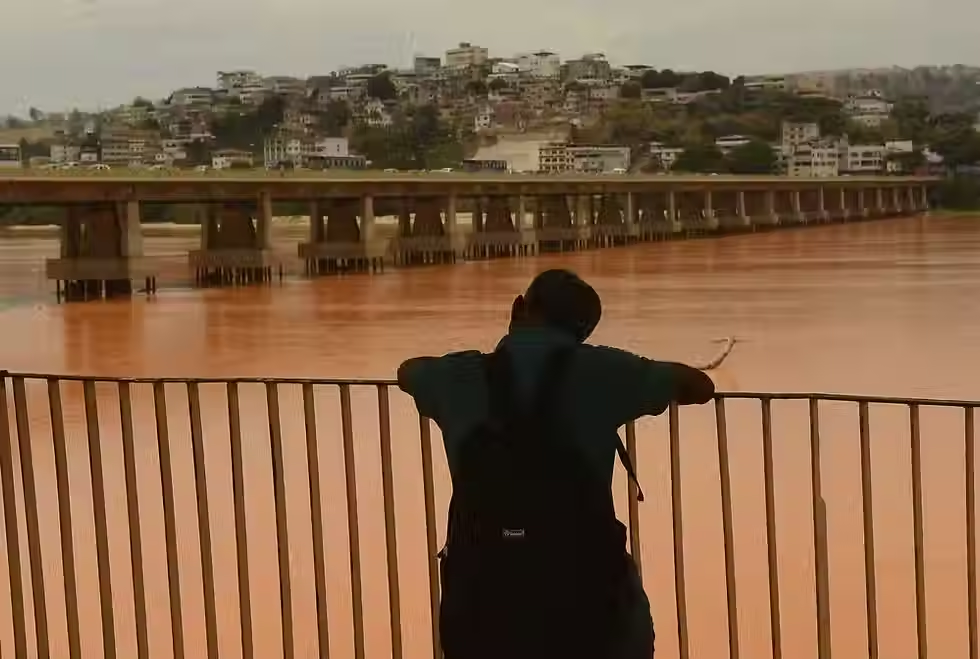
Disasters can strike suddenly. Everyone knows that.
But sometimes disasters recur.
If they recur so often, perhaps they can be prevented. Better still, perhaps we can learn from them.
I am trying to learn. That is what scientific publication is all about: learning, humbling oneself, trying to show the world that perhaps we can try to solve a problem, perhaps we can adapt to what we do not see or to what we may see but do not pay attention to.
In the article, we look at some interesting issues:
The collapse of the Fundão dam in 2015 was not just an environmental tragedy; it also exposed the fragility of our Water Resources Management (WRM) in the face of technological disasters.
Our study investigated how this integration (or lack thereof) has been addressed in the planning for the Doce River Basin.
What did we find?
We analysed the PIRH-Doce (from 2010 and 2023), as well as the terms of reference that guided the plan’s development, and the results are of extreme importance to managers and researchers:
Non-integrated planning: Historically, plans have focused on natural events (droughts and floods), treating technological disasters as ‘unexpected accidents’ outside the scope of water planning.
Minimal Adjustments: Even following the scale of the Mariana disaster, direct integration between technological risk management and water planning in official documents remains limited and focused on response, not prevention.
Cascading Impacts: Technological disasters destroy consumer infrastructure and drastically alter water quality, giving rise to new conflicts over the use of alternative water sources that were not previously anticipated.
How to move forward? 🚀 Our group proposes 14 strategic guidelines for vulnerable river basins, including:
Risk Inventory: Clear identification of companies and activities that could contaminate water in the event of accidents.
Integration with Civil Defence: Aligning long-term basin planning with joint crisis preparedness.
Adaptive Management: Creating mechanisms that allow basin plans to be ‘living’ and to adjust rapidly during and after major crises.
I congratulate my colleagues and co-authors Bruno Peterle Vaneli and Edmilson Costa Teixeira, at the Laboratory of Water Resources Management and Regional Development (LabGest), on this important contribution.
Read the full article here: https://www.abrh.org.br/OJS/index.php/REGA/article/view/1044
The answer to how to solve the problem of accident-related disasters within a water resources plan can be found in the article.
But what I really want to know, and which isn’t yet in my articles, is how can I prevent repeated disasters in this great river basin we call life? Or to repeat the title: what did the Mariana disaster teach us about planning our lives? 🤔
So, let me know in the comments. 🫡
Comments